
As a society living in the tropics—renowned for its rich forests—we often overlook the presence of endemic timber species such as Ebony, Rosewood (Sonokeling), Mahogany, Merbau, Ironwood (Ulin), Agarwood (Gaharu), Sandalwood (Cendana), Yellow Balau (Bengkirai), Meranti, Ramin, and others. These towering trees grow across forests from Sumatra to Papua and are highly sought after in international timber markets, yet remain largely unfamiliar to the Indonesian public.
One of the most well-known species in the timber market is Ramin wood (Gonystylus spp.), which is locally referred to by various names such as Setalam, Kayu Minyak, Gaharu Buaya, Medang Keran, Merang, Melawis, Ramin Batu, Ramin Telur, Akenia, Ahmin, Melawis, and Garu Buaya. This tree is regarded as a beautiful and premium hardwood due to its smooth texture, attractive color[1], hardness, versatility, straight grain, and ease of processing (Bob and Parno, 2003; Muin and Astiani, 2018).

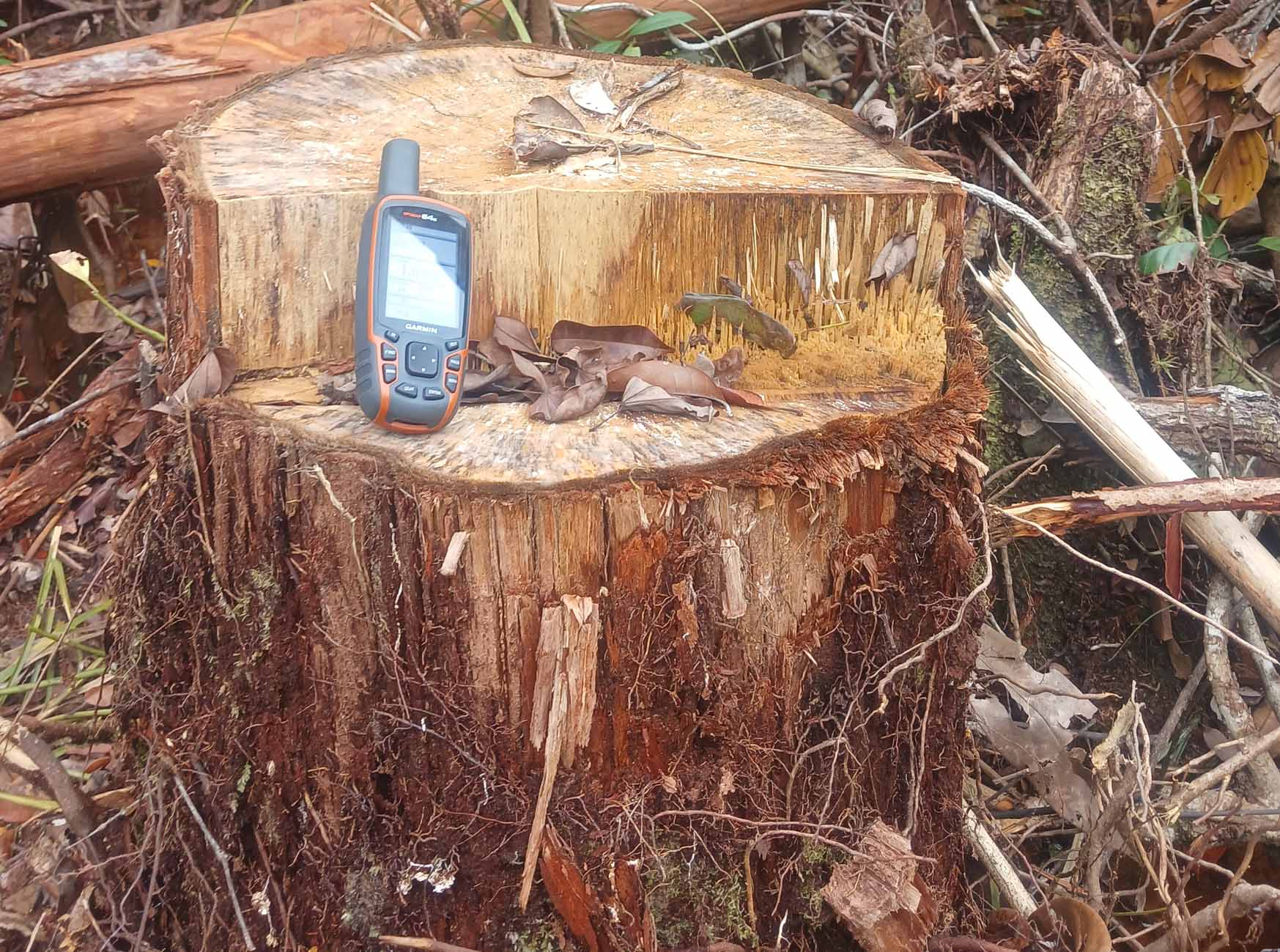
Ramin tree stump in Central Kalimantan. (Photo: IFM Fund)
This distinctive tree species typically grows in groups and thrives across Sumatra and Borneo, where it dominates freshwater lowland forests and peat swamp forests. According to a 2002 CITES report, there are 30 known species of Ramin distributed across various locations, six of which—Gonystylus affinis, G. bancanus, G. forbesii, G. macrophyllus, G. maingayi, and G. velutinus—are known for their high commercial value, hardness, and versatility.
For local communities, these trees hold cultural and practical value—often used as building materials or incense[2]. However, in the global market, they are prized for their beauty and traded in processed forms such as moldings, wooden pegs, furniture, window blinds, snooker cues, chopsticks, and more. Major consumer countries include Italy, the United States, the Netherlands, Spain, Taiwan, Japan, China, and the United Kingdom. The high demand for Ramin has led to excessive and illegal harvesting from its natural habitat (Puja Utama, 2011), pushing the species toward a critically endangered status.[3]
This species began to be heavily exploited from its natural habitat in the mid-1960s to early 1970s. During this period, Ramin wood was primarily exported in log form rather than as processed timber (Bob and Parno, 2003). The high demand in export markets led to widespread exploitation, even extending into conservation areas. At its peak in 1976, Ramin extraction from natural forests reached 1.27 million cubic meters. Encroachment into protected areas indicated that by this decade, the availability of Ramin outside conservation zones had already declined drastically.
Trade data show that during the 1970s, 1980s, and early 1990s, Indonesia regularly exported more than 500,000 cubic meters of Ramin wood, despite existing bans (a log export ban from the early 1980s and a ban on the export of all unprocessed wood since 1985). By 1998, reported Ramin exports had declined sharply to just 260 cubic meters (CITES, accessed 25/6/2025). This exploitation was not accompanied by efforts to cultivate or manage the species for conservation (Bob and Parno, 2003), even though Ramin is known for its slow and poor natural regeneration (Mansur et al., 2024; Wardani et al., 2010).
A 1998 report by the Environmental Investigation Agency (EIA) revealed that more than 7.6 million cubic meters of Ramin wood had been logged from Indonesian forests between 1980 and 1987. By 1997, Ramin production had dropped significantly to just 489 cubic meters. This decline is stark when compared to earlier data: in 1983, the Directorate General of Forestry reported Ramin potential in Central Kalimantan at 76.11 m³/ha (for trees with a diameter > 35 cm). By 2003[4]–2005[5], the standing stock of Ramin had sharply declined, signaling a trend toward extinction. According to the ITTO-CITES Project report (2010), Ramin volume fell drastically from around 131 million m³ in 1983 to approximately 15 million m³ in 2005, mainly due to illegal logging and forest land conversion.
In 2001, as part of efforts to address the issue of illegal logging, the Indonesian government decided to list all Ramin species under Appendix III of CITES and imposed a temporary ban (moratorium) on the harvesting and trade of Ramin. This was enacted through Minister of Forestry Decree No. 127/Kpts-V/2001 dated April 11, 2001, followed by Ministerial Regulation No. 168/KPTS-IV/2001 on the Use and Distribution of Ramin Wood, and Regulation No. 1613/KPTS-II/2001 banning the export of sawn Ramin wood. Subsequently, the CITES Secretariat officially listed Indonesian Ramin under Appendix III, effective August 6, 2001, through Notification to the Parties No. 2001/026.
The listing of Ramin under Appendix III was later considered inadequate in controlling its illegal trade and logging in natural habitats. Consequently, through the CITES mechanism, Indonesia successfully proposed the uplisting of Ramin to Appendix II during the 13th Conference of the Parties (CoP-13) held in Bangkok in 2004. A tri-national workshop held in Malaysia in April 2004 reached a consensus on the formation of a Tri-National Task Force, focusing on the eradication of illegal Ramin trade among Indonesia, Malaysia, and Singapore, and supporting the proper implementation of CITES procedures to regulate its trade.
However, to this day, based on data from CITES (accessed 25/06/2025), the export and import of Ramin wood continued between 2020 and 2023 in the form of wood products, processed timber, sawn wood, and wood chips. The reported figures show a total of 37,442 specimens, 3,788.44 cubic meters, and 140,600 kilograms of traded Ramin wood. The critical situation in the natural habitats of this species continues to worsen, despite its international listing under Appendix II[6], which mandates strict regulation of its trade. This means that even though Ramin is included in Appendix II, illegal logging from its natural habitat has not ceased.
[1] It can appear whitish, pale yellow, and sometimes slightly grayish, with no clear distinction between the sapwood and heartwood. The grain pattern is typically straight and interlocked (Muin and Astiani, 2018)
[2] https://tropical.theferns.info/viewtropical.php?id=Gonystylus+bancanus
[3] The IUCN Red List of Threatened Species 2018
[4] Based on records from Bob and Parno in FWI, 2003
[5] Based on records from the ITTO-CITES Project in 2010
[6] This effort was intended to control the international trade of this timber in order to curb its illegal circulation. It aims to ensure the survival of the species in the wild, given that it is not a tree with easy growth or regeneration characteristics. Continuous and indiscriminate harvesting has led to a drastic decline in its distribution in natural habitats, making it one of the world’s critically endangered tree species.