
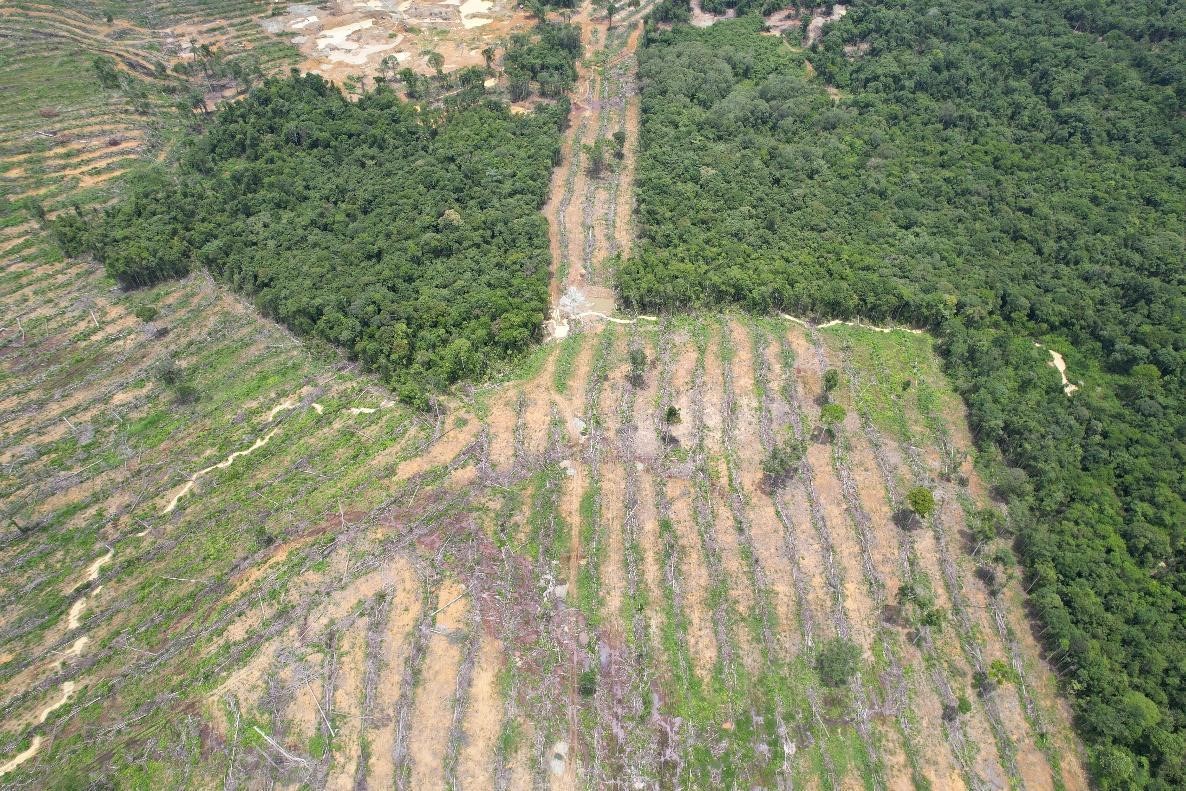
The monitoring report compiled in Voices from the Forest Edge: A Compilation of Notes from Forest Monitors in Indonesia reveals various illegal practices in forest management and indications of non-compliance by permit holders. The report, prepared by the Independent Forest Monitoring Fund (IFM Fund) in collaboration with partners across seven provinces, highlights that despite efforts to improve forest governance, illegal logging, forest exploitation by land tenure holders (PHAT), and weak protection for forest monitors and Indigenous communities remain serious threats.
The report identifies various violations occurring at different levels, including:
Papua: PT Subur Karunia Raya in West Papua, which operates under an IPK (Forest Land Clearing Permit), is suspected of clearing forests along riverbanks and damaging peatland ecosystems.
Riau and North Kalimantan: PT Satria Perkasa Agung and PT Adimitra Lestari allegedly failed to comply with the Timber Legality and Sustainability Verification System (SVLK).
Aceh and Central Kalimantan: PHAT permits are being misused to legalize logging within forest areas.
Downstream Industry: CV Almenta in East Java is strongly suspected of receiving illegal timber.
Forest Exploitation Through PHAT and IPK Schemes
Rahmad Syukur from Yayasan Apel Green Aceh stated, “We discovered the use of Land Tenure Rights (PHAT) as a means to legalize timber extracted from illegal logging in Nagan Raya Regency. This has led to severe environmental degradation and threatens Indigenous territories. In one case, a protected area was misused for commercial purposes without considering ecological impacts.”
Wancino from Kaharingan Institute added, “The PHAT scheme is highly detrimental to forests and local communities. Companies exploit legal loopholes to evade sanctions, while their illegal activities continue to destroy primary forest areas.”
Meanwhile, Sulfianto Ilyas from Panah Papua highlighted how the IPK permit system, now rebranded as PKKNK, serves as a loophole for deforestation. “Timber utilization under the IPK scheme is closely linked to deforestation, with its process primarily serving administrative requirements rather than ensuring sustainability. Weak oversight further exacerbates forest exploitation.”
SVLK Implementation Gaps and Weak Supervision in the Downstream Industry
The implementation of SVLK still presents many weaknesses. Natural Forest and Plantation Forest License Holders (PBPH) often neglect Indicator 3.2, which pertains to forest security and protection. For instance, unresolved boundary disputes frequently lead to conflicts. The lack of community involvement in boundary delineation exacerbates tenure disputes.
Raja Alpian from Yayasan Gambut stated, “SVLK implementation in plantation forests still has significant inconsistencies. Many companies fail to meet their obligations to involve local communities in boundary marking, resulting in ecosystem damage and conflicts.”
In the downstream sector, CV Almenta in East Java is suspected of mixing illegal timber with legally sourced materials. Nurul Astuti from ASET Jawa Timur revealed, “We found evidence of illegal timber mixing within East Java’s industrial supply chain. Despite the SVLK framework, weak oversight allows illegal timber to enter the market. If left unchecked, this will undermine the credibility and accountability of legality verification efforts.”
Indigenous Rights Crisis and Lack of Protection for Monitors
Maikel Primus Peuki from WALHI Papua emphasized the impact of forest conversion for the timber industry on Indigenous communities. “Forest conversion in Papua displaces Indigenous territories and threatens cultural and food sustainability. Tenure conflicts between Indigenous communities and permit holders persist. In one case, Indigenous people lost access to their ancestral land, which was replaced by large-scale oil palm plantations, directly affecting their survival.”
Deden Pramudiana from IFM Fund stressed the importance of protecting forest monitors and Indigenous communities. “This monitoring report reflects the real conditions on the ground. Although efforts have been made to enforce regulations and improve permit holder compliance, illegal practices continue.”
Recommendations for Improving Forest Governance
Based on these monitoring findings, independent forest monitors urge the government and stakeholders to take concrete actions:
Enhance transparency in forest management, including open access to business permits and certification audit results.
Strictly enforce laws against illegal logging and penalize non-compliant companies without favoritism.
Ensure legal protection for independent forest monitors, including security guarantees for field monitoring and protection against discrimination and intimidation.
Without decisive action, forest governance will remain uncertain, while illegal logging and forest exploitation continue to threaten Indonesia’s forests. Forest monitors emphasize that meaningful governance reform can only be achieved through transparency, law enforcement, and protection for monitors.